The best marketing attribution software for most paid-ads teams is Triple Whale if you run a Shopify store, Northbeam if you spend heavily across many channels, and Hyros if you sell calls, courses or high-ticket offers.
Attribution tools give you a second opinion on what Meta, Google and TikTok report, but none of them prove causation; for that you still need an incrementality test.
How we picked: we compared public product pages, vendor pricing pages, public app-store reviews and the results in our own database. We have not used these tools ourselves.
| Tool | Best for | Starting price (as of November 2026) | Free plan or trial | Rating (source) |
|---|---|---|---|---|
| Hyros | Info products, coaching, call-based sales | Custom quote | No public trial; "you don't pay" guarantee | Not verified |
| Triple Whale | Shopify brands | Free plan; paid plans quoted by GMV | Free plan | Not verified |
| Northbeam | Multi-channel DTC brands with large budgets | $1,500/month (Starter) | No trial listed | Not verified |
| Cometly | B2B SaaS and lead gen | Custom quote by pageviews | No free trial | Not verified |
| Wicked Reports | Subscription and repeat-purchase brands | $499/month | No trial listed | Not verified |
| Polar Analytics | Shopify brands that want BI plus attribution | $750/month (Core) | Demo store | 4.9/5, 116 reviews (Shopify App Store) |
| Rockerbox | Brands that also buy TV, podcasts or direct mail | Demo / contact sales | No | Not verified |
| Haus | Incrementality tests and causal MMM | Demo / contact sales | No | Not verified |
Why platform attribution over-counts
Every ad platform grades its own homework. Meta's standard setting credits a sale to an ad if the buyer clicked within 7 days or viewed it within 1 day, so Meta, Google and TikTok can all claim the same order.
The gap can be large. @SamPiliero shared an agency client whose incremental ROAS was 3.01x over the trailing 12 months.
Incremental ROAS counts only the sales the ads caused, not every sale they were credited with.
Small campaigns can look absurd too. In another screenshot from @SamPiliero, a retargeting campaign spent $0.02 and showed a purchase ROAS of 51,287. That is attribution credit, not ad-driven profit.
We collect more examples like this in platform claims vs results.
Third-party attribution tools help by tracking orders with their own pixel and deduplicating credit across channels.
They still use rules or models, so treat them as a better ruler, not the truth.
The 8 best marketing attribution tools for paid ads
1. Hyros
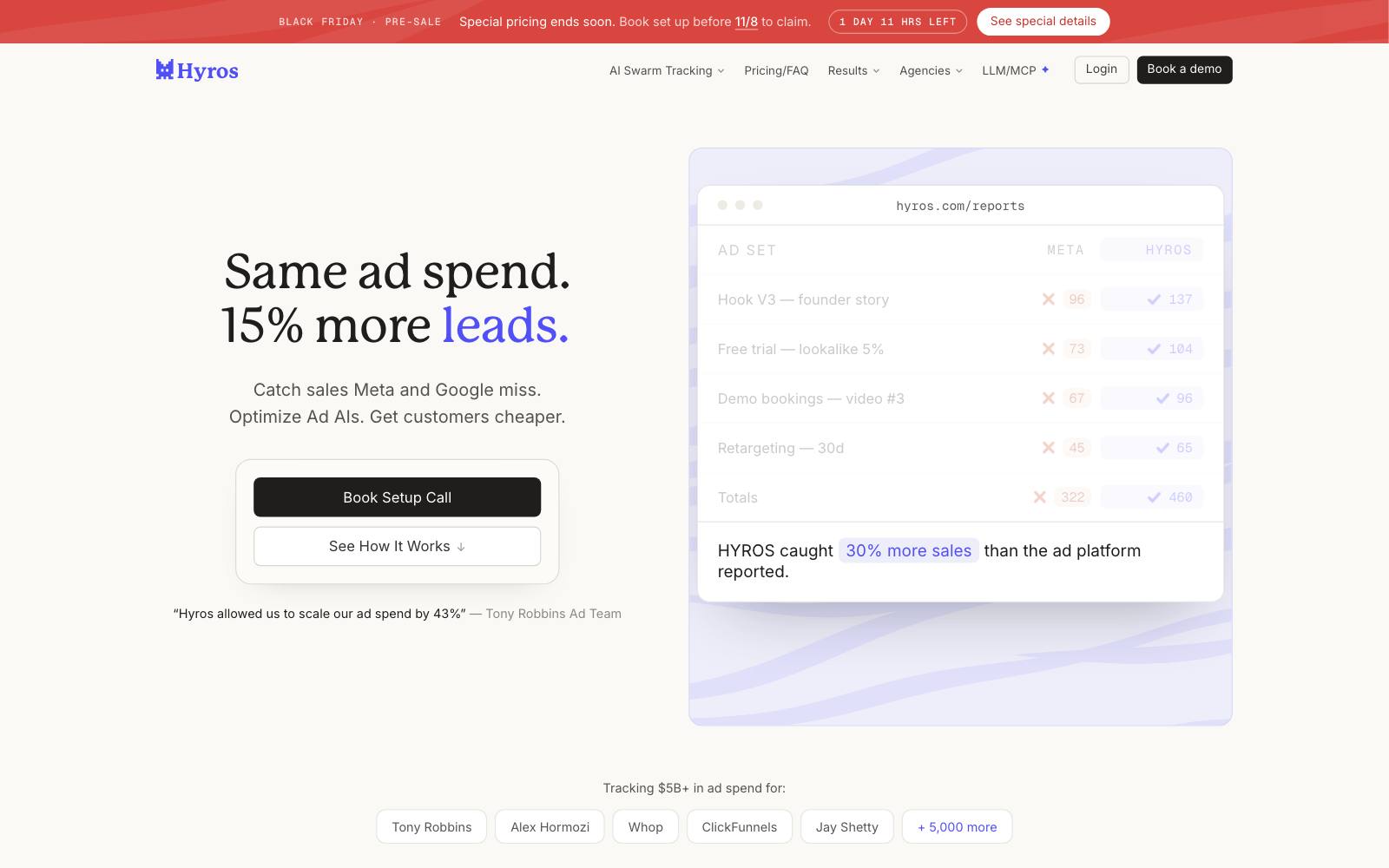
Best for: info products, coaching, SaaS and B2B offers that close on calls, where the sale happens days or weeks after the click.
What it does: Hyros is ad tracking and attribution software that says it catches sales Meta and Google miss.
It tracks across Meta, Google, TikTok and email, then sends those sales back to the ad platforms to improve their optimization.
Key features:
- "AI Swarm Tracking" across ad platforms and email
- Call tracking for booked calls and closed deals
- Conversion feedback to ad platforms
- A Claude MCP interface for custom dashboards and models
Pros:
- Built for long, call-based sales cycles that ecommerce tools handle poorly
- One plan with setup team included, per the pricing page
- Performance guarantee: "Your ads grow or you do not pay" (vendor's wording)
Cons:
- No public prices; you get a quote on a setup call
- Headline claims like "15% more sales" are vendor-reported, not independent
- Less of a fit for a simple Shopify store that mostly needs a dashboard
Pricing: one custom plan, quoted on a call and sized to your business model and revenue, as of November 2026.
We may earn a commission if you sign up through our Hyros link.
More detail in our Hyros review, or compare options in Hyros alternatives.
2. Triple Whale
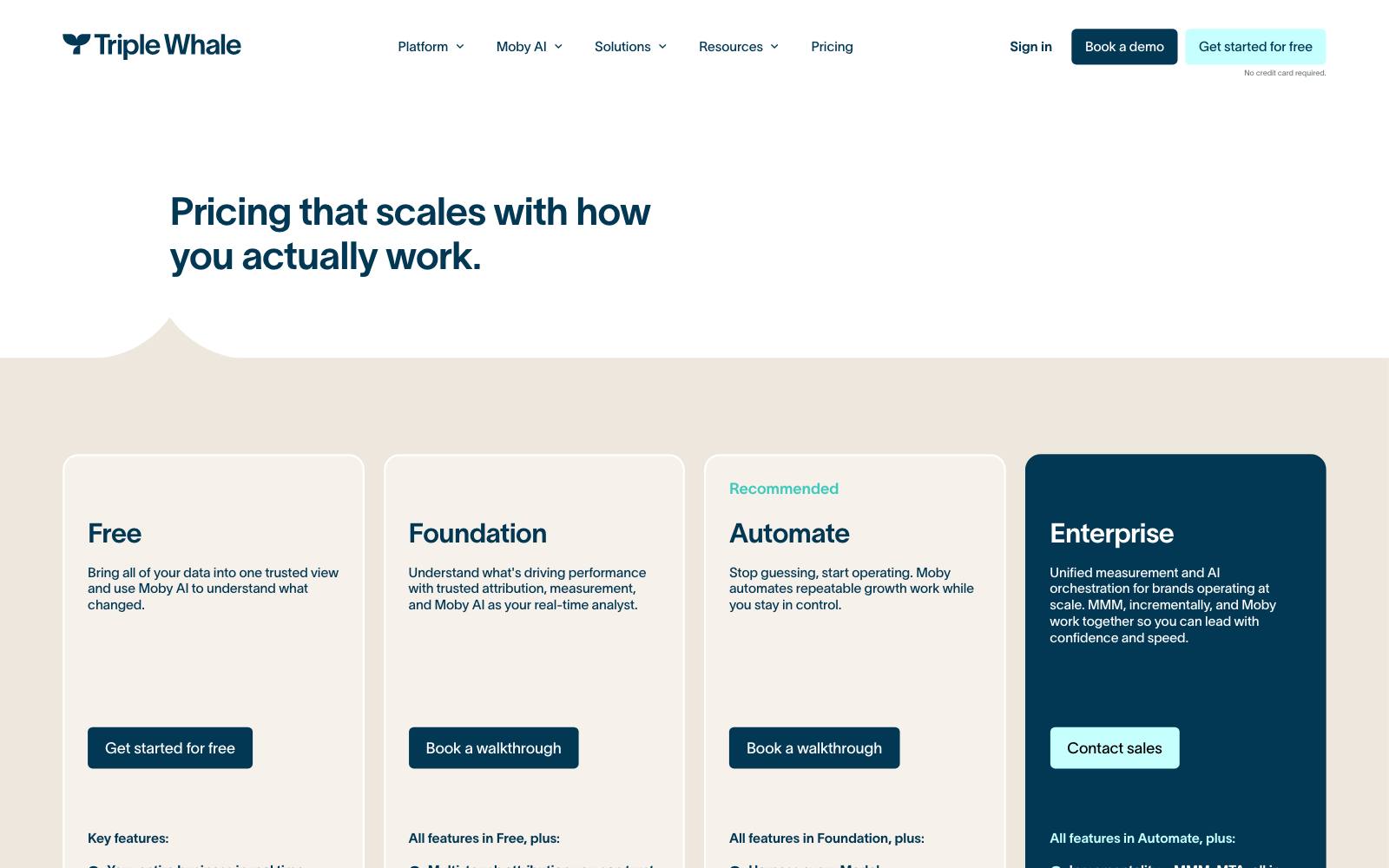
Best for: Shopify brands that want attribution, BI dashboards and an AI analyst in one place.
What it does: Triple Whale tracks orders with its Triple Pixel and shows first-click and last-click attribution on the free plan.
Paid plans add multi-touch attribution, a SQL editor and Moby AI; Enterprise adds holdouts, geo-lift tests and MMM.
Key features:
- Triple Pixel for cross-device order tracking
- Multi-touch attribution on paid plans
- Moby AI for questions, reports and automations
- Signal push-back to ad platforms
Pros:
- Real free plan, so you can see the data before paying
- Unlimited users on every paid plan
- Incrementality and MMM available in the same tool at Enterprise level
Cons:
- Paid prices are not public; they depend on annual GMV and package
- Your plan moves up automatically as revenue grows
- Built around ecommerce; not for lead gen or B2B
Pricing: free plan; Foundation, Automate and Enterprise quoted on annual GMV, as of November 2026.
See our Triple Whale review and Triple Whale alternatives.
3. Northbeam
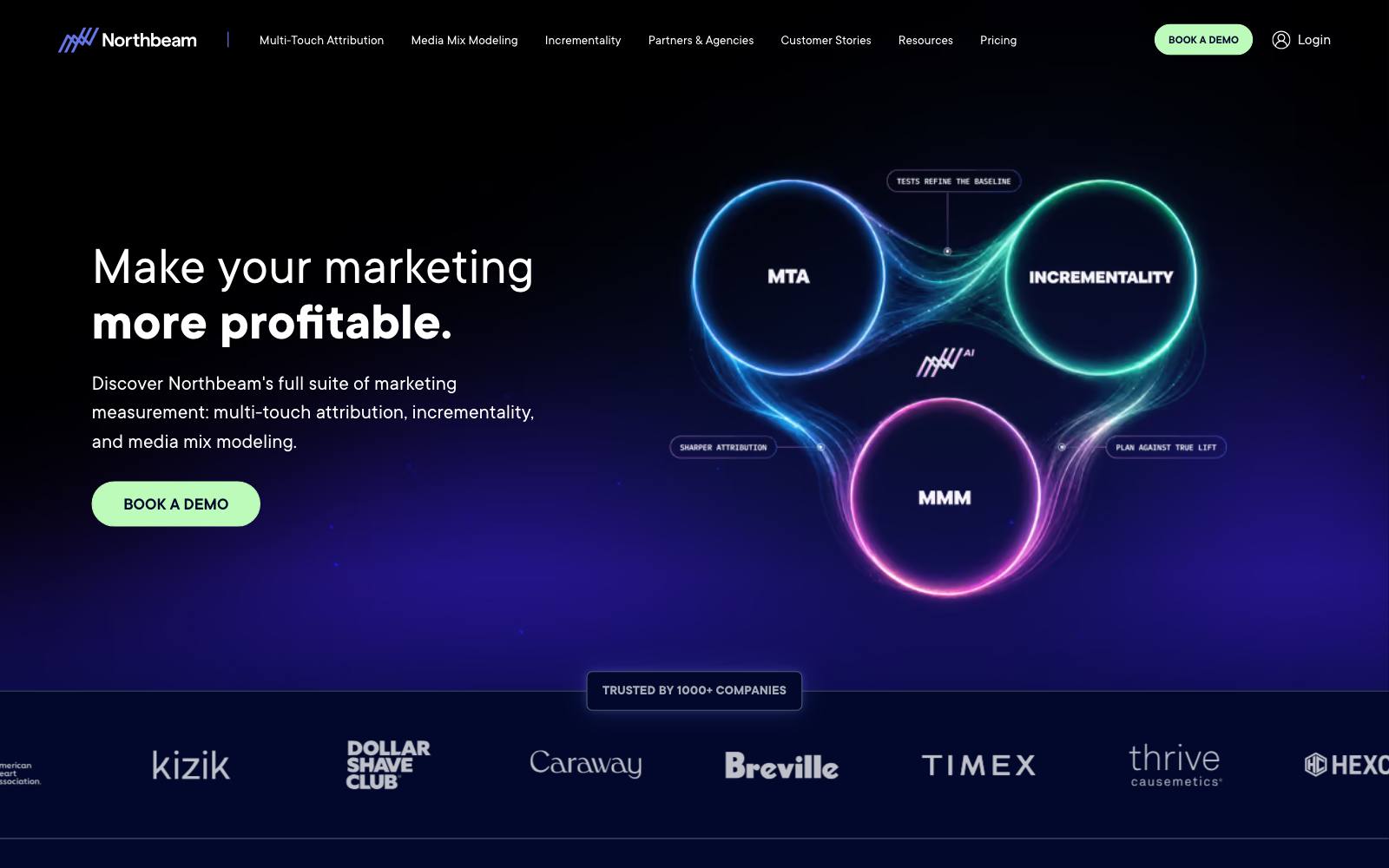
Best for: DTC brands spending across five or more channels, including video and display.
What it does: Northbeam offers multi-touch attribution, a "Clicks + Deterministic Views" model for video reach, and MMM+ for forecasting.
Its Apex integration sends performance data back to ad platform algorithms.
Key features:
- Multi-touch attribution across channels
- View-through attribution for video campaigns
- MMM+ budget scenarios
- Creative and product analytics
Pros:
- Public starting prices, unlike most rivals
- New-customer metrics (new MER, new visits) by channel
- Higher tiers include a media strategist
Cons:
- $1,500/month entry price is steep for small stores
- Price rises with pageviews, so traffic spikes can cost more
- Claimed averages (37% ROAS increase for enterprise customers) are vendor-reported
Pricing: Starter $1,500/month for brands spending under $1.5M a year, Professional $3,500/month, Enterprise custom, as of November 2026.
In our archive: @runtraffic broke out Google Display as its own prospecting channel, with figures that appear to come from Northbeam: MER 1.69 and 82% new visits.
That is the kind of channel-level view platform dashboards don't give you.
Weighing the two big ecommerce tools? Read Northbeam vs Triple Whale.
4. Cometly
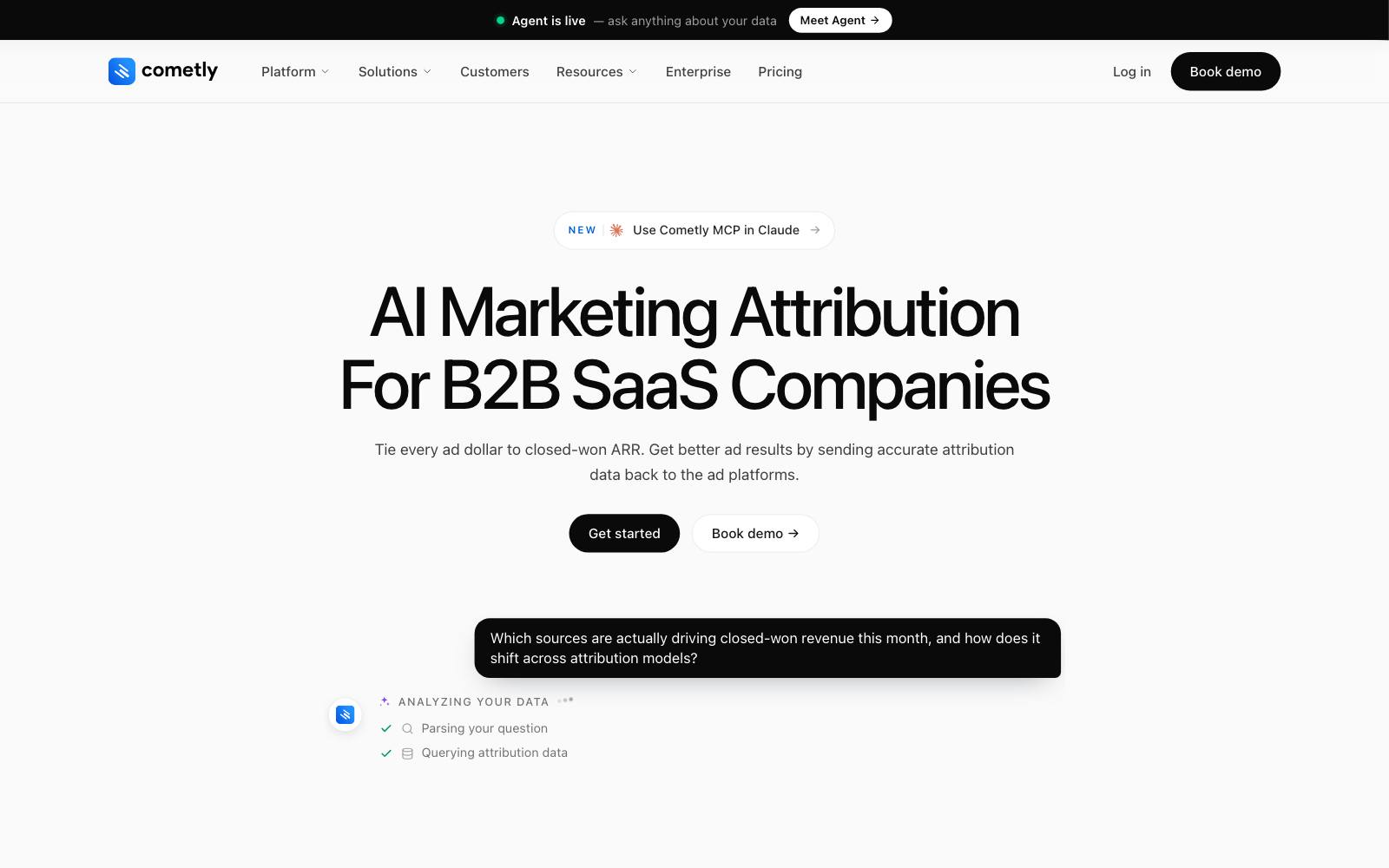
Best for: B2B SaaS and lead-gen teams that need to tie ad spend to closed revenue in a CRM.
What it does: Cometly connects ad platforms, CRMs like HubSpot and Salesforce, and Stripe to tie ad spend to closed-won revenue.
It syncs paying-customer events back to Meta, Google and LinkedIn through conversion APIs.
Key features:
- First-touch, last-touch, linear, U-shaped and data-driven models
- Conversion API sync to Meta, Google and LinkedIn
- 70+ native integrations and warehouse sync
- Plain-English AI agent, also available over MCP
Pros:
- Strong fit for lead-to-revenue tracking
- Choice of attribution models side by side
- Annual billing saves 20%
Cons:
- No free trial; Cometly says attribution needs CRM setup to be useful
- No public prices
- Positioned mainly for SaaS, so ecommerce teams may find better-fit tools
Pricing: usage-based on monthly pageviews, custom quote, as of November 2026.
5. Wicked Reports
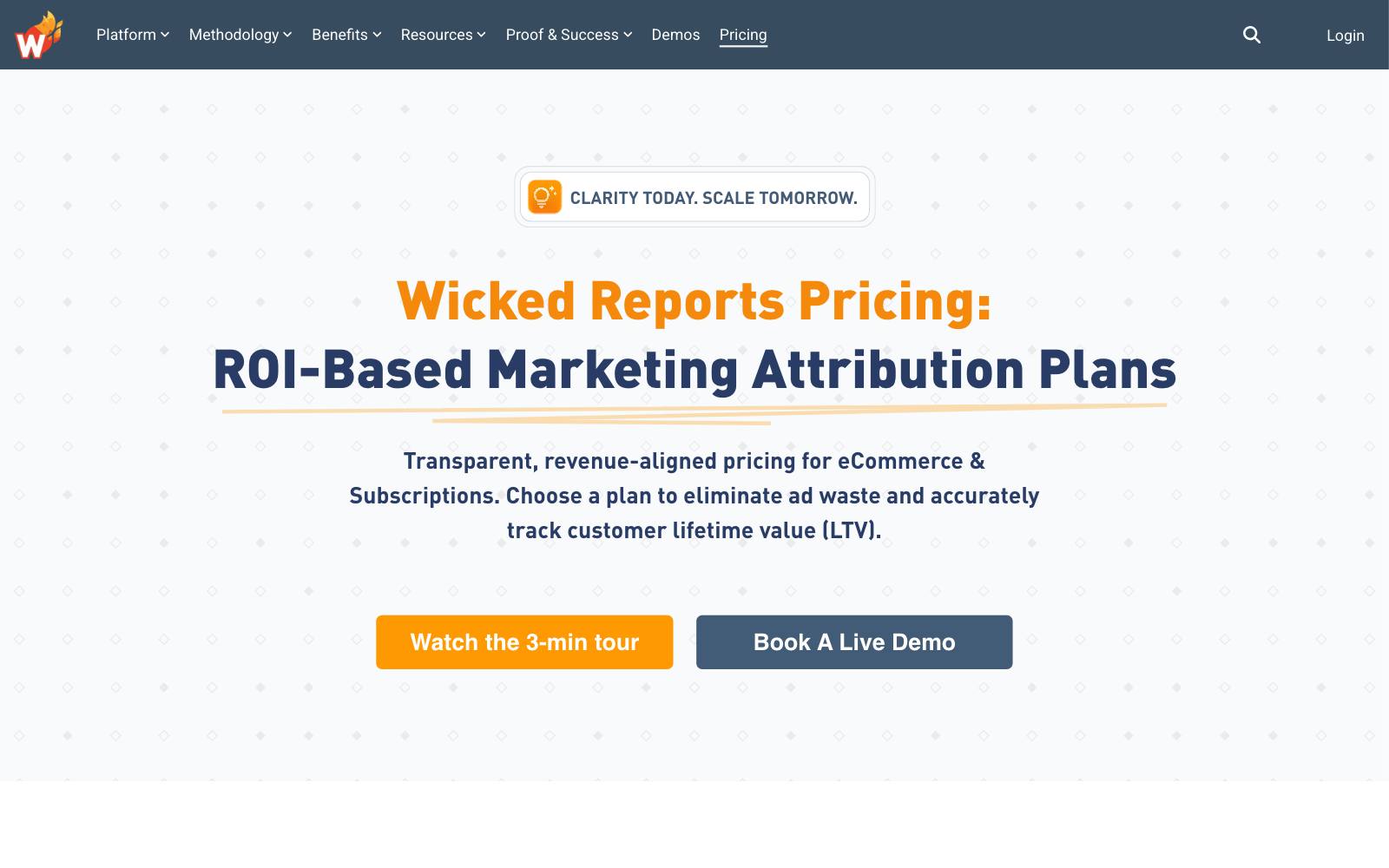
Best for: subscription and repeat-purchase brands that care about cohort LTV, not just first-order ROAS.
What it does: Wicked Reports offers pre-built attribution views (FunnelVision) plus cohort and LTV reports.
Higher tiers add "Advanced Signal" Meta CAPI and its 5 Forces AI.
Key features:
- FunnelVision pre-built views
- Cohort and LTV reporting
- Meta CAPI signal (add-on or Maximize tier)
Pros:
- Fully public prices
- Upgrade or downgrade any time, per the pricing page
Cons:
- Key features cost $199/month extra each on lower tiers
- Tier jumps when your trailing 12-month revenue crosses a threshold
Pricing: Measure $499/month (revenue $0 to $2.5M), Scale $699, Maximize $999, Enterprise from $4,999, as of November 2026.
6. Polar Analytics
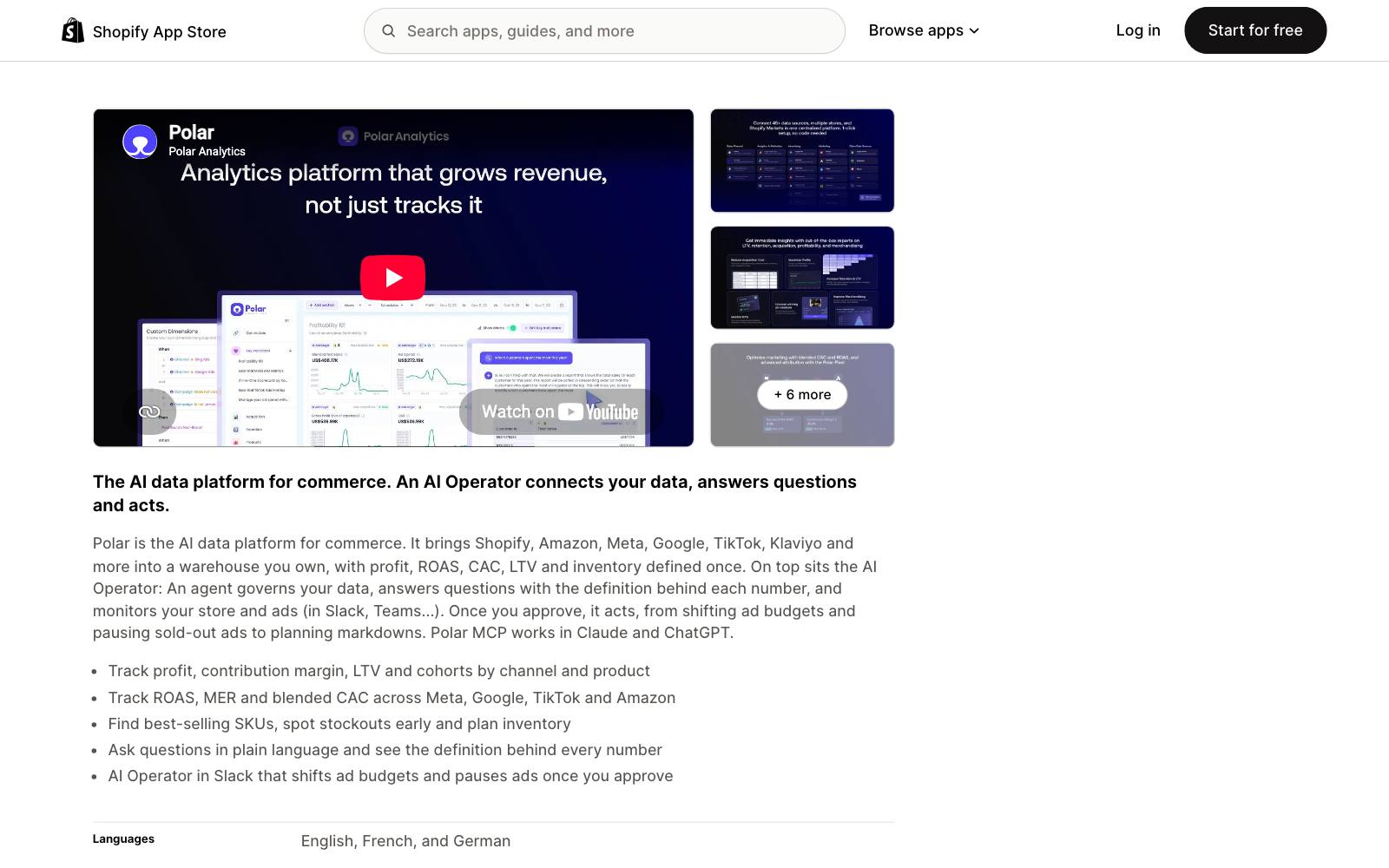
Best for: Shopify brands that mainly want clean BI and LTV data, with attribution as part of it.
What it does: Polar pulls Shopify, Amazon, Meta, Google, TikTok and Klaviyo into one set of dashboards.
Its BI product includes multi-touch attribution, and incrementality testing is sold separately.
Key features:
- Multi-channel dashboards and custom reports
- LTV, CAC and ROAS tracking
- Paid incrementality tests per test or per quarter
Pros:
- Strong public reviews
- Can grow from dashboards into lift tests
Cons:
- $750/month start is high if you only need attribution
- Test pricing is not shown publicly
Pricing: Core from $750/month, based on online GMV, as of November 2026.
Rating: 4.9/5 from 116 reviews on the Shopify App Store.
7. Rockerbox
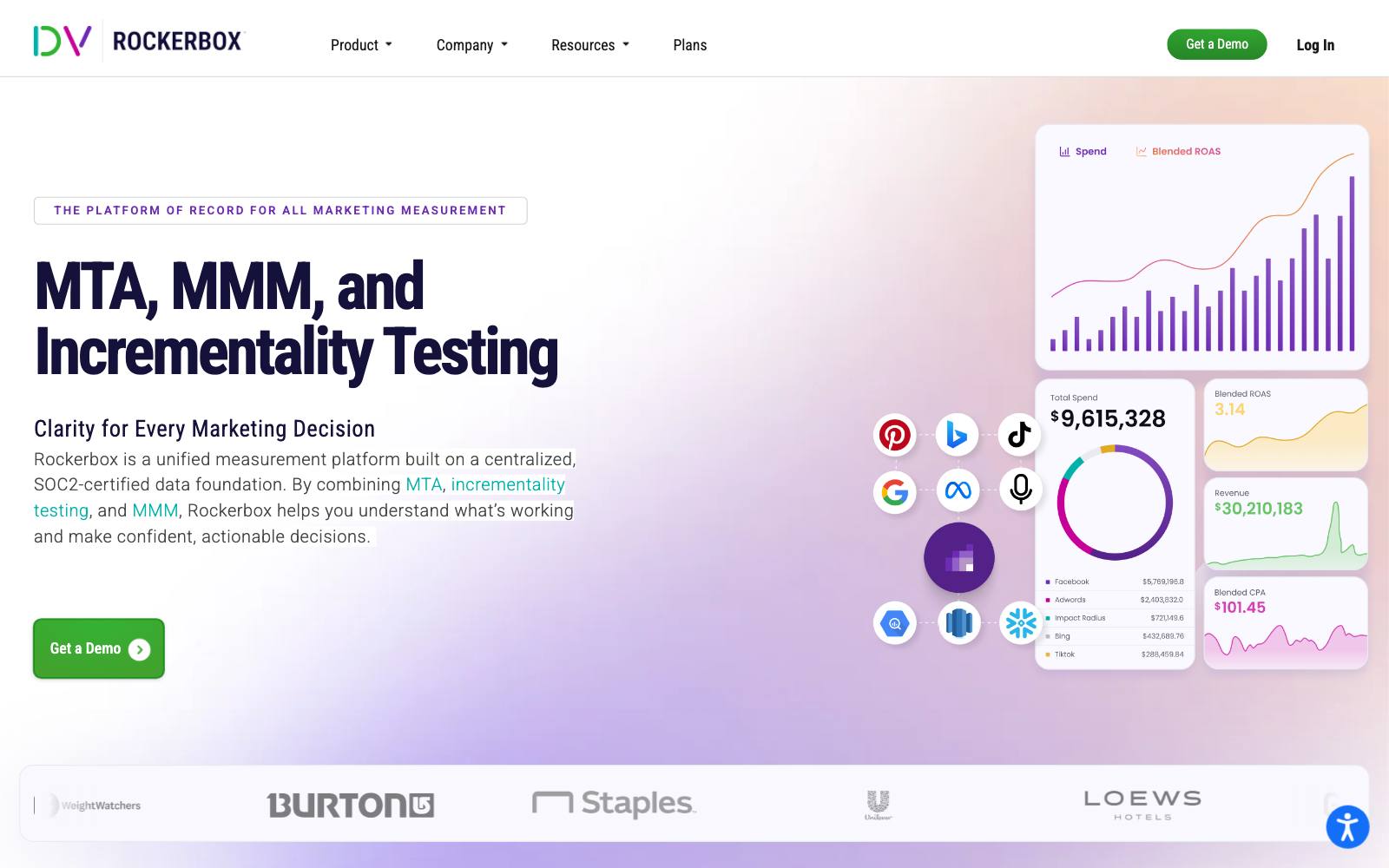
Best for: larger brands that also spend on CTV, linear TV, podcasts or direct mail.
What it does: Rockerbox, now part of DoubleVerify, combines multi-touch attribution, MMM and incrementality testing.
It lists 100+ integrations covering digital and offline channels.
Key features:
- MTA for campaign-level decisions
- MMM for budget planning
- Incrementality tests to check both
Pros:
- Covers offline channels most ecommerce tools ignore
- Three methods in one place, so you can cross-check numbers
Cons:
- No public pricing or free tier
- Overkill for a brand only running Meta and Google
- Its Away Travel case ("6x higher" Meta impact than last click) is vendor-reported
Pricing: demo and contact sales, as of November 2026.
8. Haus
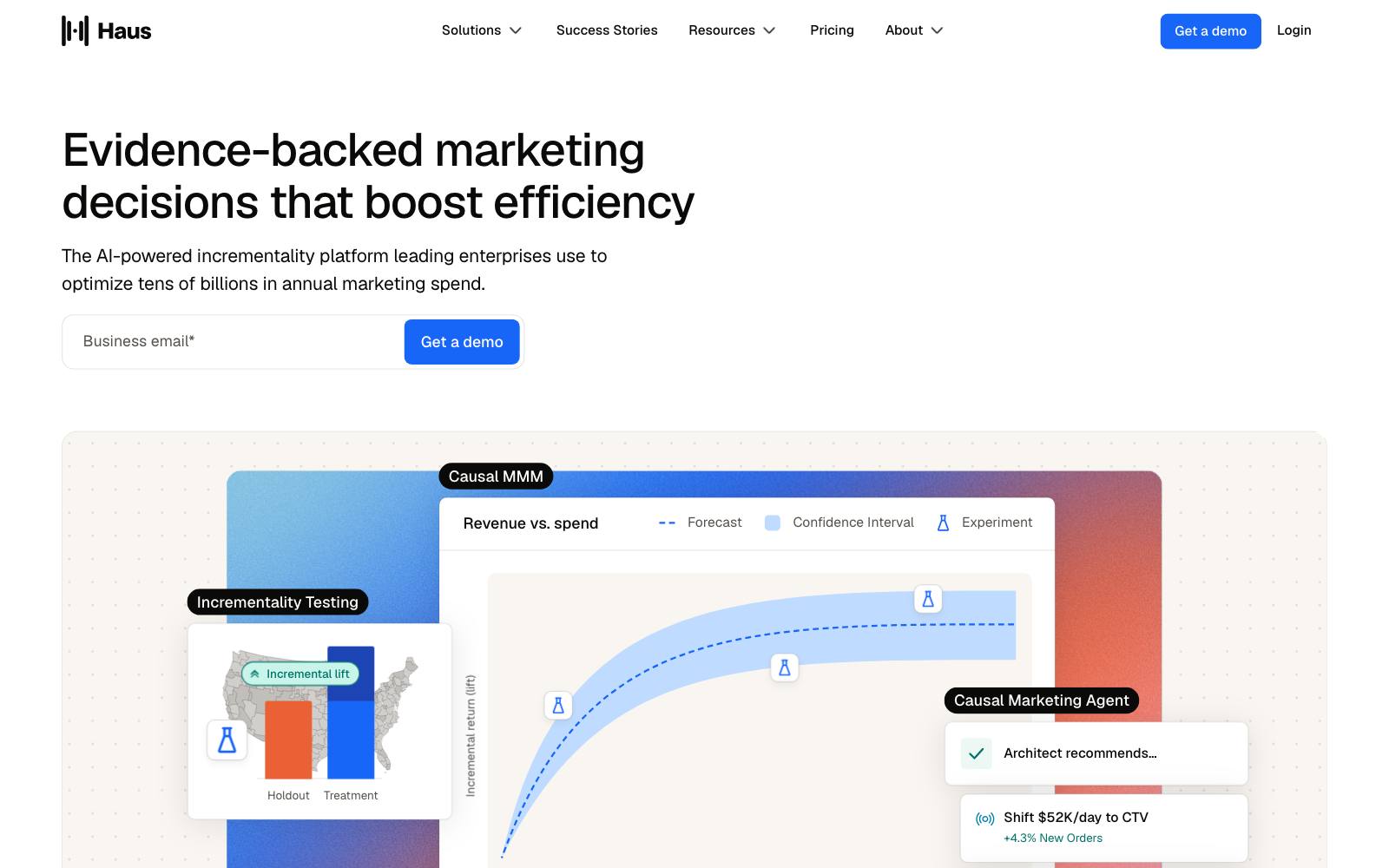
Best for: brands ready to replace modeled credit with controlled experiments.
What it does: Haus runs geo-based incrementality experiments, then feeds them into a causal MMM and causal attribution.
Its Basics tier covers self-serve US geo tests on Meta, Google and TikTok for Shopify and Amazon brands.
Key features:
- Geo holdout experiments
- Causal MMM with weekly updates
- Testing for influencers, podcasts, OOH and TV on the Plus tier
Pros:
- Answers "did this cause sales," not "who touched the order"
- Tiers from self-serve to enterprise
Cons:
- No public prices or minimums
- Experiments need time and enough volume to read; not a daily dashboard
Pricing: four tiers (Basics, Core, Plus, Enterprise), demo required, as of November 2026.
In our archive: @runtraffic shared a brand search incrementality study with incremental ROAS of 8.17 and new-customer ROAS of 1.17.
That split is what a lift test shows that attribution cannot.
Pricing compared
Most attribution software hides prices. As of November 2026, only three of our eight picks publish a dollar figure:
- Wicked Reports: from $499/month, tiered by trailing 12-month revenue.
- Polar Analytics: from $750/month, based on online GMV.
- Northbeam: from $1,500/month, scaled by pageviews.
Triple Whale has a free plan, with paid tiers quoted by GMV.
Hyros, Cometly, Rockerbox and Haus quote on a call.
Our own rough rule of thumb, not a benchmark: if a tool costs more than about 5% of your monthly ad spend, the insight has to move a lot of budget to pay for itself.
Small accounts often get more from fixing conversion API setup and watching MER.
Incrementality vs attribution
Attribution splits credit for sales that happened. Incrementality testing asks how many sales would have disappeared without the ads, using holdout or geo groups.
The two can disagree sharply. In a vendor-reported LiftLab case, reallocating YouTube prospecting spend produced about $1.9M in incremental revenue.
A practical setup: use an attribution tool for daily and weekly decisions, then run a lift test once a quarter on your biggest channel to calibrate it.
If budget is tight, Google's Meridian is an open-source MMM you can run yourself, provided you have the data skills.
Which one is right for you
Shopify store under $1M a year
Start with the Triple Whale free plan. Upgrade only once you know which question the free data can't answer.
DTC brand spending across many channels
Northbeam or Triple Whale. Northbeam leans on view-through and MMM+; Triple Whale on AI and BI.
Courses, coaching and call-based offers
Hyros, which is built around call tracking and long sales cycles.
Results from any tool vary by offer and setup.
B2B SaaS and lead gen
Cometly, for CRM-to-ad revenue tracking.
Subscription brands
Wicked Reports, for cohort LTV by source.
Large brands with TV, podcasts or mail
Rockerbox for unified measurement, or Haus if you want experiments first.
If you'd rather have a media buyer who already works with these tools set things up, we can introduce you.
What to look for in attribution software
- Your sales model: ecommerce checkout, booked calls and SaaS trials need different tracking.
- Server-side signal: check that it sends conversions back to Meta and Google, not just reports them.
- New vs returning split: new-customer ROAS or MER tells you if ads are finding new buyers.
- Model choice: you should be able to compare first-click, last-click and multi-touch side by side.
- Path to incrementality: a built-in lift test or an easy way to calibrate against one.
- Pricing driver: GMV, revenue or pageviews; know how your bill grows.
- Setup help: bad tracking setup makes any tool wrong.
Real results on attribution and measurement
Watch out for
- Tool shopping for a better number: a tool that shows higher ROAS isn't more accurate.
- Vendor averages: "15% more sales" or "37% higher ROAS" come from the vendors themselves.
- Two pixels, two truths: pick one source of truth for budget decisions and keep it.
- Tiny-spend outliers: ignore ROAS on campaigns with almost no spend.